A powder coating oven looks simple from the outside — a big insulated box with a door. But what happens inside that box is what separates a finish that lasts a decade from one that fails in a season. Here's how a curing oven actually works, system by system.
What a curing oven has to do
After powder is sprayed onto a part electrostatically, it's just dry dust clinging to metal by static charge. The oven's job is to melt that powder so it flows into a continuous film, then hold the part at the powder's cure temperature — typically 350–400°F — long enough for the chemistry to crosslink into a hard, bonded coating. That takes three things: enough heat, even heat, and accurately controlled heat. Each of the oven's core systems exists to deliver one of them.
The four systems inside a powder coating oven
1. The insulated cabinet
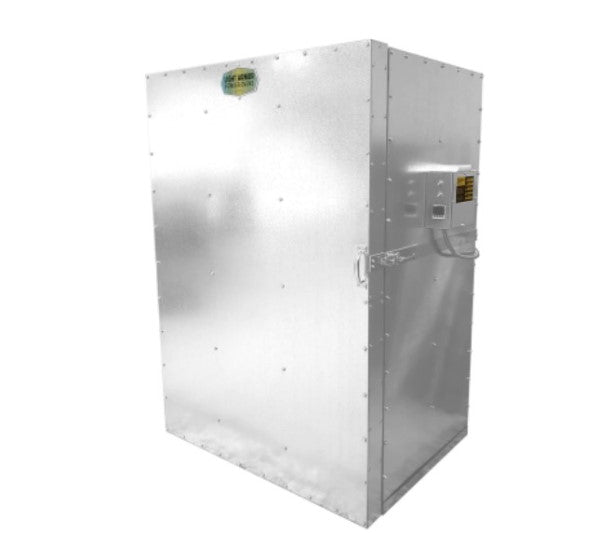
The oven body is a double-walled steel cabinet with high-temperature insulation between the walls. Insulation does two jobs: it lets the oven reach and hold 400°F+ without roasting your shop, and it's the main driver of operating cost — a well-insulated oven holds temperature with the elements barely cycling, while a poorly insulated one bleeds heat (and electricity) continuously. Light Armor ovens use galvanized steel construction for rust resistance in shop environments.
2. Electric heating elements
Heat comes from electric resistance elements — the same principle as a kitchen oven's elements, scaled up. Element wattage determines how fast the oven climbs to temperature and how quickly it recovers after you open the door to load parts. Bigger chambers need more wattage: our benchtop and small ovens draw around 14A at 240V, while the largest models draw 56A. (Planning a circuit? See our electrical requirements guide.) Electric elements have a big advantage over gas burners for coating work: no combustion byproducts inside the chamber, no gas plumbing, and finer control.
3. Air circulation
Hot air rises, so an unstirred oven is hotter at the ceiling than the floor — which means the top of a tall part cures faster than the bottom. Convection airflow evens this out, moving heated air around the load so every surface of every part sees the same temperature. This matters more the bigger the oven and the fuller the load, which is why a blower fan is one of the most popular options on our mid-size and large ovens. Even heat is also half the story of cure quality — the other half is covered in our cure times and PMT guide.
4. The PID controller and thermocouple
The brain of the oven. A thermocouple inside the chamber continuously reads the air temperature and feeds it to a PID controller, which cycles the heating elements to hold your set point tightly — anticipating overshoot and undershoot rather than just switching at a threshold like a cheap thermostat. That's what lets you run a powder's data-sheet schedule (say, 400°F for 15 minutes) with confidence. Every Light Armor oven ships with a PID controller with timer and temperature functions; older ovens can drop in the updated LCD controller.
What a cure cycle looks like, start to finish
- Preheat. The oven climbs to the powder's cure temperature with the elements at full output.
- Load. Parts go in on hooks or racks. Opening the door drops the air temperature; the controller drives the elements to recover it within minutes.
- Flow-out. As parts heat up, the powder melts around 300°F and levels into a smooth, glossy film.
- Soak and cure. Once the part metal itself reaches the target temperature, the cure clock starts. The controller holds the set point while the powder crosslinks — typically 10–20 minutes.
- Cool-down. Parts come out and cool until the coating hardens fully. Handle with care until they're back near room temperature.
Why not just use a kitchen oven?
For a one-off tiny part, people try. But kitchen ovens swing widely around their set point, have no timer tied to actual cure logic, can't fit anything meaningful, and — most importantly — an oven used for curing coatings should never be used for food again. A purpose-built curing oven solves all of that, and small ones are more affordable than most people expect: see the benchtop LA Mini or our full curing oven lineup. For the middle path some hobbyists consider, we've written honestly about DIY builds vs. buying.
Batch vs. conveyor
Everything above describes a batch oven — load, cure, unload — which is what the vast majority of shops need. High-volume production lines use conveyor ovens where parts ride through a heated tunnel continuously. Batch ovens win on flexibility, footprint, and price; if you're coating varied parts in sets rather than thousands of identical pieces, batch is the answer.
Wondering what size oven your parts need? Start with our part-by-part sizing guide, or send us your biggest part's dimensions and we'll match you to a model.


